By Peter Martin of the Sunday Times
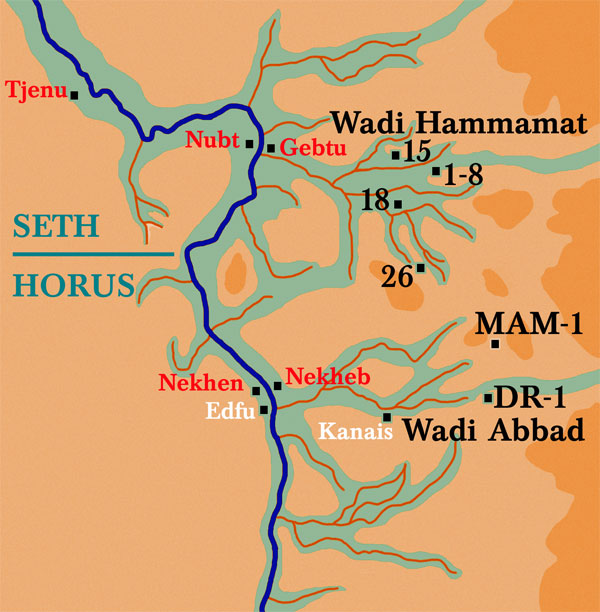
The Eastern Desert, situated between the Red Sea and the Nile, is a fairly barren place that has never much caught the interest of archeologists. An exception was Hans Winkler, who, when he came here in the 1930s, recorded scads of ancient rock carvings depicting strange high-prowed ships, right here in the desert. Winkler died puzzled, and nobody laid eyes on the carvings again until the Egyptologist David Rohl, on an expedition here in 1997, recognised them as an extraordinary archeological scoop.
The Eastern Desert Survey Expedition.
Most of us have a passing familiarity with the wonders of ancient Egypt, if chiefly with Tutankhamun’s fabulous burial treasure. But the big mystery is how such a sophisticated culture sprang up so quickly, as if from nowhere, and how this ties in with civilisation's best-known founding story, the Old Testament.
Rock-art boat from the Wadi Barramiya.
The Eastern Desert rock carvings depict an epic journey made by a godlike people – exotic and terrible strangers – who, by what looks to have been a surprise invasion of Egypt, dragged their large reed ships overland from the Red Sea to the Nile. These were plainly warships, with up to eighty oars apiece, their chieftains armed to the teeth and pointing westward. Great lines of other men are shown dragging the ships with ropes. Strategically, you can see how it could have worked: haul the ships two-thirds of the way, get into the dried-up river beds, then wait for the annual high Nile to carry you to war at eighty-oar speed.
Rohl is convinced that these invaders came from Mesopotamia at the onset of the third millennium BC: “We can tell this from their style of weapons, ship design, their dress and their religious symbolism”, he says. “They carry pear-shaped maces, far more lethal than the disc-shaped maces the Egyptians used at that time, and their ships are typical Mesopotamian seagoing vessels. Their chieftains wear tall twin plumes, and kilts with animals’ tails attached. I've linked them with the mythical ‘followers of Horus’ because the carvings feature the falcon god, Horus”.

Rohl’s interpretation of these rock-art sequences as an all-out invasion of Egypt neatly elides, with an archeologically famous ceremonial knife. Unearthed at nearby Gebel el-Arak, it was made in the same era as the invasion. Carved on its ivory handle is the world’s oldest pictorial record of a battle. “And we know who won it”, says Rohl, “because it shows the long-haired Nile valley dwellers succumbing to the pear-shaped maces of the short-haired invaders. We also see the high-prowed boats knocking the hell out of the people in the crescent-shaped Nile boats, who are shown drowning”.
Further evidence strongly suggests that these foreigners eventually became the pharaohs: “Within 500 years, in pyramids and tombs, we begin to see all this Mesopotamian symbolism now become part of Egyptian culture. The gods wear tall twin plumes, the kings have tails attached to their kilts, and the bodies of the pharaohs are dragged to their underworld tombs in high-prowed ships. After the falcon god in the rock carvings, we soon get the Horus kings of Egypt. We see pharaohs smiting their enemies with pear-shaped maces and, as with King Tut, they're all depicted wearing false beards, as if imitating the divine heroes of Mesopotamia”.
But what has all this to do with civilisation’s founding story, as told in the Old Testament (OT)? According to Genesis, following Adam's ancestral line from the Garden of Eden, through Noah and the flood, it was Ham’s second son, Mizra, who came with his tribe and settled Egypt. Still today, an Egyptian will refer to himself as a descendant of Masr. Not just a phonetic similarity, it’s an etymological fit.
As civilisation’s founding stories go, the OT is no means an exclusive. The Sumerian and Akkadian epics come to us from Mesopotamia, written down for the first time – in cuneiform script on clay tablets – circa 2,500 BC. Albeit with different names, they tell the same story – the first of all stories – involving the same principal characters. Like Eve in the OT, in Mesopotamian legend ‘the Lady of the Rib’ is banished from eternal life in heaven. Next, there’s Noah, the exact double of the Sumerian flood hero Utnapishtim. Both send out doves from the ark to find dry land. Later, Noah's great-grandson, Nimrod – warrior, mighty hunter and builder of the great city of Erech – has his twin in the Sumerian saga of Enmerkar, ‘Enmer the Hunter’, the warrior and builder-king of Uruk. Same man, same city?
But of all Rohl’s evidence for the adoption of Mesopotamian culture by Egypt, here's a language detail to lift the hair on your neck. The odd epithet ascribed to the ancient Mesopotamian flood hero, ‘the far distant’, is the exact meaning of the Egyptian word ‘Horus’. This takes you from Noah to the pharaohs in just one word.

That Rohl packs more into one book than most archeologist-historians would attempt to set down in a lifetime is only the half of it. In his latest work, The Lost Testament, he upsets convention, very ably demonstrating that the OT was in part based on real people and actual events. Following the Mesopotamian invasion of Egypt, he pieces together Joseph’s life as Pharaoh's right-hand man, through to how Moses came to learn the true name of God – Yahweh – to the exodus, the Israelites’ storming of the Promised Land, and the extraordinary rise of King Saul and King David, ending with the fall of Jerusalem to Nebuchadnezzar in the sixth century BC – 5,000 years of history delivered at a tremendous lick. If, here and there, Rohl’s evidence reads a little thin, it’s chiefly because he’s attempted to tell a seamless story for a lay audience. At the back of each chapter, however, he presents his evidence cold.
Of course, conventional academic wisdom holds that the OT is little better than a fairy story because no archaeological evidence for it has been found. On the contrary, says Rohl. There’s evidence galore, and all sorts of specialists have been staring at it for decades. The mistake, he argues, is that the ancient world has been dated wrongly. Take Joshua and his Israelite army destroying the city of Jericho. Jericho’s tumbled walls are still there, along with storage jars, the grain inside burnt to a cinder, consistent with Joshua's infamous torching of the city. The glitch is that orthodox chronology would place Joshua at the end of the Late Bronze Age, when no such fortified cities were built. Hence, either Joshua was born too late to have had anything to do with Jericho, or he never existed. Everyone's problem, of course, is that there were no calendars BC, only tantalisingly incomplete king lists and dynastic records. All we have, then, are evidence-based interpretations – and ferocious arguments.
When Rohl first advanced his new chronology in A Test of Time, published in 1995, he got some awful stick. The leading Bible scholar Professor Thomas L Thompson insisted that any attempt to write history based on a direct integration of biblical and extra-biblical sources was "not only dubious but wholly ludicrous". The very architect of Egyptian chronology, Professor Kenneth Kitchen, dismissed Rohl’s thesis as "98% rubbish".
Undeterred, in his next book, Legend, Rohl advanced new discoveries relating to the Book of Genesis. Indeed, as readers of The Sunday Times may recall, he even gave a geographical fix for the Garden of Eden, in Iran, based on his deciphering of the ancient language names of four rivers given as co-ordinates in Genesis, chapter two. For our story, we went and we saw, including a place ‘east of Eden’, as described in Genesis, that is still called Noqdi, the Land of Nod.In the interim, the pendulum of serious opinion has begun to swing Rohl’s way. Dr Ronald Wallenfels, for example, the curator of New York’s Metropolitan Museum, and an Assyrian specialist, says there's plenty of flexibility in the ancient Assyrian dates. Given that all chronologies are interdependent, the same flexibility would inevitably apply to the Egyptian time line. Just recently too, one of Rohl’s peers, an American Egyptologist, cold-canvassed a number of other Egyptologists with a single question: if you were to place the Israelite sojourn and exodus in any period in history, what would it be? The majority picked the middle Bronze Age, concurring with Rohl.
Of all OT characters, the best drawn is Abraham's descendant Joseph, but Rohl gives him the evidential kiss of life. This – to remind you – is Joseph of the coat of many colours, whose jealous brothers had him sold as a slave into Egypt. Eventually, his talent for dream interpretation brings him to the attention of Pharaoh, who has had a nightmare of seven emaciated cattle rising up out of the Nile to devour seven fat cattle. As Joseph divined it, seven years of plenty would be followed by seven of famine, and he urged Pharaoh to reorganise the nation's grain supply against the lean time to come. Joseph, the Hebrew foreigner, got the job of vizier of all Egypt.
Pharaoh Amenemhat III.
But did it happen, and if so, what caused the famine years? In 1844 a German Egyptologist discovered a series of flood records – water heights chipped into cliff faces just south of the Nile's second cataract. Dating from the late 12th Dynasty, when Rohl’s chronology places Joseph in Egypt under Pharaoh Amenemhat III, the records show flood heights of nine metres above normal. The American hydrologist Barbara Bell recently calculated that, on those reckonings, the Nile valley would have been inundated with four times the usual volume of water, making seed-sowing impossible for several years and famine inevitable.
The OT also tells us that Joseph, as part of the now-centralised grain strategy, forced Egypt’s landowners to sell him their stocks. Intriguingly, the 12th-Dynasty archeological record shows that tomb building for regional chieftains suddenly ceased, as if they’d been dispossessed. Separately, contemporaneous Egyptian papyrus documents mention the setting up of an agricultural office called ‘the Department of the People's Giving’. Grain to be handed in for later redistribution in the famine years?
The Bahr Yussef.
Stronger evidence suggests that reorganising Egypt’s grain supplies was by no means Joseph's only great work. We know from Diodorus Siculus, writing in the first century BC, that a canal was dug to drain off the Nile’s destructive inundations. Today, in the Arabic, the canal is still known as Bahr Yussef, the Waterway of Joseph. At the time, Amenemhat III was so taken with the canal, he had his pyramid built overlooking it.
Rohl’s research has produced evidence that Joseph, a Hebrew regarded as the saviour of Egypt, had his own palace at Avaris in the part of the Nile delta known in the OT as Goshen. As per the OT too, Hebrews were now so welcome in Egypt that they soon became very influential in Egyptian affairs, and the archeology concurs: wealthy Semitic graves at the Middle Bronze Age level have been found at Avaris. Joseph, at his death, unheard of for a foreigner, was entombed in a small pyramid in the grounds of his palace, with a chapel containing his colossal cult statue.
On Rohl’s reading, it was following a series of weak 13th-Dynasty pharaohs, with consequent political chaos in Egypt, that the Hebrews were infamously pressed into slavery. Grimly tallying, Middle Bronze Age documents have yielded up pharaonic slave lists with Hebrew names, and the tin-pot grave goods of an underclass have been unearthed at Avaris. When excavated, Joseph's pyramid tomb turned out to be empty. "But that’s consistent with his dying wish to be returned to the Promised Land," argues Rohl. "At the Exodus, they took his body with them”. What was found in the chapel of the tomb, however, was a busted-up painted statue of an Asiatically pale fellow with reddish hair adorned with the multi-coloured coat of a Middle Bronze Age chieftain.
Although seemingly outrageous, Rohl’s bold placing of these events in time, often to the very year, has lately been vindicated by independent researchers, here and in the United States, in the complex field of astronomical dating. What they did was to retro-calculate the dates of astronomical events – chiefly eclipses and moon phases – as described in the ancient texts. And the results? Rohl had fixed the coronation date of Joseph’s pharaoh, Amenemhat III, at 1678 BC. It turned out that he had missed by just four years, and has since tweaked his time line accordingly.
Also, in a head-to-head contest, Rohl's placing of Amenemhat III in the seventeenth century BC resulted in 37 out of 39 lunar month-length matches, whereas orthodox chronology – which keeps its options open with two possible placings – scored no better than 21 matches. The astronomer Dr David Lappin of Glasgow university, concluded: “Most of the astronomical data – particularly the 12th-Dynasty lunar dates simply do not fit with the orthodox chronology, while the support it gives to David Rohl’s new chronology is nothing less than startling”.
So let's revisit Jericho for a moment. The Book of Joshua describes the Israelites destroying not just Jericho but also the cities of Ai, Debir, Hebron and Hazor. “And the king of Hazor is actually mentioned by name – King Jabin, who was personally knifed to death by Joshua” says Rohl. “Now, at Hazor they've found a tablet with the name Jabin on it. And where? In the same Middle Bronze Age levels that mark the destruction of Jericho”.
The Jabin Tablet from Hazor.
Of all the scoops in The Lost Testament, Rohl's marshalling of evidence for the late-eleventh-century life and times of King Saul is so impressive that it makes the orthodoxy look like a flat-Earth proposition. Background: at the same time that a politically complacent pharaoh, Akhenaten, came to power in Egypt, the Israelites found themselves with a fierce warrior leader in Saul. Saul – Shaul in Hebrew – was not his actual name, but an epithet meaning ‘asked for (by the people)’ that was given to him by the later Bible writer.
So who was this first king of Israel, what was his real name, and what evidence is there, outside the OT, of his existence? One of the great finds of the mid-nineteenth century was the el-Amarna letters, 3,000-year-old eyewitness accounts, in the form of 380 clay tablets, that represent the correspondence sent to Pharaoh Akhenaten by his vassal rulers. They tell of a new and belligerent Habiru rebel leader called Labaya. Some letters from vassal kings complain to Pharaoh that Labaya keeps making war on them. Others, from Labaya himself, reveal a crafty long-game specialist.
Akhenaten in whose capital the Amarna Letters were found.
The thing to grasp here is that the orthodox time line fixes Saul and his Hebrew army at a distance of three centuries from Labaya and his Habiru fighters. In Rohl’s chronology, however, they come up as exact contemporaries. But are they the same man? Judge for yourself.
As per the OT, Saul, having declared his war of liberation, seized the two towns of Gibeah and Michmash. Similarly, in a letter from Labaya to Pharaoh, the Habiru chieftain argues that his recent taking of two towns was justified because they were his in the first place. Bolshie in the extreme, this particular letter not only omits the customary obeisance – ‘I am the dirt under your feet’ – but issues Pharaoh with a veiled warning – “If an ant is struck, does it not fight back and bite the hand of the man that struck it?”
More persuasive that Labaya was Saul is their identical family politics. In the Bible account, Saul was enraged by the close friendship of his son Jonathan with the rebel mercenary David. Since David was also Saul's son-in-law, he and Jonathan should have been rivals for the kingship. Instead, famously, they doted on each other. In the OT, Saul cursed Jonathan as the “son of slut” – and you can see why. At one point, his bosom pal David and his Hebrew mercenaries were fighting on the side of the Philistines against Saul. And guess what: Labaya, in an ostensibly embarrassed letter to Pharaoh, protests that he didn't know that his son was consorting with the Habiru.
The name of one of the rebel leaders in the Amarna Letters, Tadua – an epithet bestowed on him by his Hurrian warriors – means “the beloved”. The Hebrew name David also means ‘the beloved’, which in its earlier, Canaanite form would have been written as Dadua. But the clincher is that Saul and Labaya shared exactly the same death. As in the OT, so in the Amarna Letters, both die in battle – against a coalition of city-states from the coastal plain – on or near Mount Gilboa, both as a result of betrayal.
Combining information from both the Bible and the Amarna letters, Rohl has reconstructed the course of the battle. At first, it seemed that Labaya/Saul couldn't lose. He was at the top of Mount Gilboa, and the only access for Philistine chariots and archers was protected by his ally Tagu. But Tagu had done a treacherous deal with the Philistines and, in a surprise onslaught from the rear, Labaya was mortally wounded. Rather than be taken in shackles to Egypt for ritual slaughter, however, he fell on his own sword.
Rohl completes this chapter with a stunning flourish. The OT also tells us that Saul's body was taken from Mount Gilboa to the fortress of Beth-Shean, beheaded there, and hung on the wall. Three thousand years later, in 1993, the excavators of Beth-Shean found a fragment of a small cylinder seal, the sort used for quick communication between allied commanders in battle. Cylinder seals usually came with a string attached for hanging them around your neck. The Beth-Shean seal fragment reads: “To Labaya, my Lord, speak. Message from Tagu: ‘To the king my Lord. I have listened carefully to your message from me’”. The rest is missing. Let Rohl savour it: “So here we have a message from the traitor Tagu, probably delivered to King Labaya/Saul before the battle on Mount Gilboa, then carried here to Beth-Shean still around the king’s neck, fallen to the ground when he was beheaded”.
But what of David? Later in the OT, King David, as he now is, storms and takes Jerusalem. Among the Amarna letters is a plea from Abdi-Heba, the ruler of Jerusalem, begging Pharaoh for reinforcements against the besieging Habiru army. Then the pleas stop. Jerusalem has fallen.
The final battle between the Philistines and the all-conquering Hebrews is described in both the OT and the Amarna Letters as having taken place in exactly the same spot – just outside Jerusalem, in the Vale of Rephaim. One difficulty in fixing King David as a real historical figure was the lack of evidence outside the ancient texts. Until just under a decade ago that is, when a stone stela fragment bearing the phrase ‘The House of David’ was found in the city of Dan, incorporated into a 2,800-year-old wall.
Ramesses II.
As after a round of musical chairs, not the least effect of Rohl’s New Chronology is that many ancient figures have switched thrones. That of mighty Ramesses II of the 19th Dynasty, once thought to be the repressive Pharaoh of the Exodus, is now taken by Dudimose, a petty king of the 13th Dynasty. Ramesses, meanwhile, becomes a contemporary of the Israelite King Solomon, David’s son. Orthodox chronology puts Solomon in the relatively impoverished early Iron Age. But, as described in the First Book of Kings, Solomon’s reputation as a successful merchant king sits far better in the wealthy Late Bronze Age.
Take his fabulous palaces, commissioned from the best of ancient stonemasons, the Phoenicians. They used three rows of fine-cut stone, topped by a cedar beam, backfilled with rubble to protect the structure against earth tremors. Today, Solomon's Late Bronze Age gate at Megiddo is a perfect example. No similar construction technique was used in the early Iron Age, where orthodoxy places Solomon.
Sunday Times Magazine front cover picture (1995).
A nonbeliever, Rohl has no religious mission to vindicate the Old Testament. “I don't doubt that I've got some of the details of this historical reconstruction wrong”, he says, “but I find the big picture so convincing. If I am wrong, so be it – but let’s see the evidence, not the dogma”.


.jpg)


.jpg)


.jpg)


.jpg)